
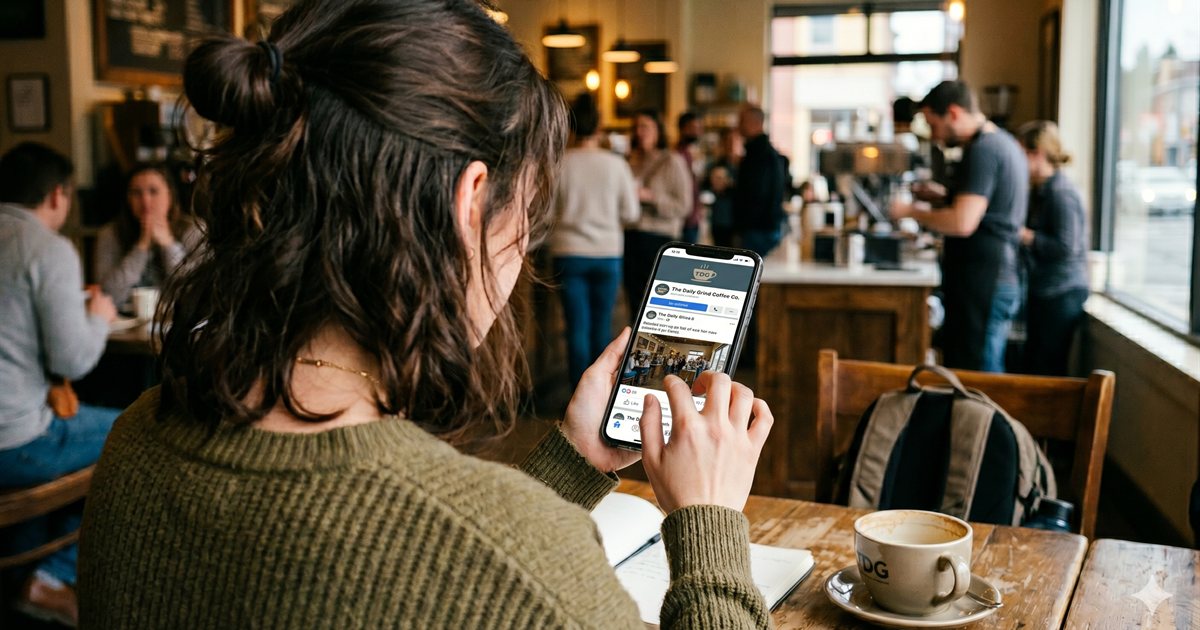
A Facebook page reaches just 1 to 2% of your followers, and 76% of people check your online presence before visiting. Here's why your business needs a website.
Someone hears about your business from a friend. They pull out their phone, type your name into Google, and a Facebook page comes up. To see your hours, they have to log in. The last post is from four months ago, and the cover photo is two renovations old. That person has a decision to make about whether to call you, and you're barely there to help them make it.
If your business lives on a Facebook page and nothing else, that's the moment it quietly costs you. A Facebook page is a fine place to be social. It's not a great place to be found, trusted, and contacted by someone who's ready to buy.
This guide walks through what a Facebook page can and can't do for a small business, where your customers are actually looking, and why a website you own beats a page you rent. We'll keep it practical, and we'll be honest about the times a page really is enough.
TL;DR: A Facebook page reaches only about 1 to 2% of your followers, down from 16% a decade ago (Hootsuite, 2025), and people find local businesses on Google more than on Facebook (SOCi, 2023). A website is the one piece of your online presence you actually own. Keep the page, but build the site.
Isn't a Facebook Page Basically a Website?
Not really, because you don't own it. On Facebook, you're a renter. The average organic reach of a Facebook Page post has fallen to roughly 1 to 2% of your followers, down from about 16% in 2012 (Hootsuite, 2025). The platform decides who sees you, and it changes the rules whenever it wants.

Think about what renting means here. Your page looks like every other page, so you can't stand out. Your posts compete with vacation photos and cat videos for a sliver of attention. If your account gets locked or flagged, your entire web presence is gone overnight, and there's no easy way to take your followers with you.
Organic reach on a Facebook Page has fallen by roughly 90% in a decade. Source: Hootsuite, 2025.
A website is different. You own the address, the design, the content, and the list of people who visit. Nobody can change the rules or switch it off but you.
Key Stat
A Facebook Page now reaches only about 1 to 2% of its followers organically, down from roughly 16% in 2012 (Hootsuite, 2025). On a social platform you are a renter: the algorithm decides who sees you, and you cannot move your audience or control your presence the way you can on a website you own.
Where Are Your Customers Actually Looking?
Mostly Google, not Facebook. In the past 30 days, people found local businesses through Google Search (72%) and Google Maps (51%) more often than Facebook (49%) (SOCi, 2023). Eight in ten people search for a local business at least once a week, and a lot of them do it from their phone.

Here's why that matters. About 76% of people check a company's online presence before they visit in person (Visual Objects, 2021). When someone searches for what you do, you want to be the result they find and trust. A Facebook page rarely shows up for searches like "plumber near me" or "best bakery in Rome NY." A website built for local search can, especially paired with a Google Business Profile.
More people find local businesses on Google than on Facebook. Source: SOCi, 2023.
Being found on Google is its own skill, and it starts with having a real site to be found. For the steps that follow, see our guides to local SEO for small businesses and ranking on Google Maps.
Key Stat
In the past 30 days, consumers found local businesses through Google Search (72%) and Google Maps (51%) more often than Facebook (49%) (SOCi, 2023). A Facebook page rarely ranks for searches like "plumber near me," while a website built for local search can, especially when paired with a Google Business Profile.
Does a Facebook Page Make You Look Legit?
A website makes you look more established, and looks drive trust. About 46.1% of people judge a business's credibility on visual design alone (Stanford Web Credibility Research), and visitors form a first impression of a site in roughly 50 milliseconds (Sweor, 2023). That first impression happens before they read a single word.

Now picture the two options side by side. One is a login wall and a generic blue header that looks identical to every other page on the platform. The other is a clean site with your name, your colors, your services, and a clear way to get in touch. Which one looks like a business that's been around and plans to stay?
This isn't about being fancy. It's about not losing people in the first few seconds. About 88% of visitors are less likely to return after a bad experience (Sweor, 2023), and you don't get a second shot at that first impression. We wrote more about that split-second judgment in our 5-second website test.
Key Stat
Roughly 46.1% of people judge a business's credibility on visual design alone (Stanford Web Credibility Research), and visitors form a first impression of a website in about 50 milliseconds (Sweor, 2023). A clean, branded website signals an established business in a way a generic, login-walled Facebook page cannot.
What Can a Website Do That Facebook Can't?
Quite a lot, because you control every part of it. A page lets you post and reply. A website lets you turn a curious visitor into a paying customer on your terms, day or night. Here's what you get when you own the space:
Show your services your way. Lay out exactly what you offer, with the prices, photos, and details that matter, instead of squeezing it into a profile built for everyone.
Show up on Google. A website is what ranks for the searches your customers actually type. Around 46% of all Google searches have local intent (HubSpot), and a page can't compete for most of them.
Capture leads after hours. A contact form, a quote request, or an online booking works at 11 p.m. when you're asleep. Our look at contact forms versus chatbots versus phone covers which converts best.
Build your own list. Email and phone numbers collected on your site belong to you, so you can follow up without paying to reach your own audience.
Collect and show reviews. A site is a natural home for the social proof that wins customers. If you're not asking yet, start with how to ask for reviews.
Key Stat
A website lets a small business present its services, rank in search, and capture leads around the clock, none of which a Facebook page does well. About 46% of all Google searches have local intent (HubSpot), and a contact form or booking tool on your own site converts visitors into customers even when the business is closed.
Do You Have to Choose Between Facebook and a Website?
No, and the businesses that do best use both. Think of your website as home base, the place you own and control, and Facebook as one of the roads that leads people there. The page keeps you social and top of mind. The site closes the deal and gets you found on Google.
The two even reinforce each other. About 75% of consumers regularly read online reviews when researching a local business, and Google is the most-used review platform at 81% (BrightLocal, 2024). A strong website, an active Google Business Profile, and a Facebook page that points back home work together far better than any one of them alone.
Our take: We'd rather you own the thing your customers find. Post on Facebook all you want, but send people to a site that's yours. Renting your whole presence from a platform that can change the rules tomorrow is a risk you don't need to take.
Key Stat
A website and a Facebook page work best together, not as either-or. About 75% of consumers regularly read online reviews when choosing a local business, and 81% use Google to read them (BrightLocal, 2024). The smart setup is a website as owned home base, with social profiles and a Google Business Profile pointing customers to it.
Isn't a Website Expensive and Complicated?
It costs less than most owners expect, and you don't have to build it alone. Most professional small business sites land between $3,000 and $15,000, with do-it-yourself builders running far cheaper (GoDaddy, 2026). A simple, clean site that gets you found and makes contact easy doesn't need to be a big project.
The right starting point depends on your business. We broke down the real numbers in how much a small business website costs, and compared the popular platforms in Wix versus Squarespace versus custom. The honest summary: start with what you need today, not the most expensive option on the menu.
Most small businesses still on Facebook alone are part of a shrinking group. About 83% of small businesses now have a website, up from 64% in 2018, leaving roughly 17% still offline (Clutch, 2025). The longer you wait, the more that gap shows.
Frequently Asked Questions
Can I just use my Facebook page instead of a website?
You can, but you'll miss customers. People find local businesses on Google Search (72%) more than Facebook (49%) (SOCi, 2023), and a Page reaches only 1 to 2% of your followers (Hootsuite, 2025). A website is the only piece you fully own.
Will a website help me show up on Google?
Yes. A Facebook page rarely ranks for the services people search, while a website built for local search can. About 46% of Google searches have local intent (HubSpot). Pair your site with a Google Business Profile for the best results, as we cover in our Google Maps ranking guide.
Do I still need Facebook if I have a website?
Often yes. Keep it for staying social and reaching the followers you already have, then point them to your site to learn more, book, or buy. Use both, with the website as the home base you control and Facebook as one road that leads there.
How much does a small business website cost?
Most professional builds land between $3,000 and $15,000, with do-it-yourself builders far cheaper (GoDaddy, 2026). The right number depends on what your site needs to do. We walk through the full breakdown in how much a small business website costs.
Your Website Is the One Thing You Own
A Facebook page is worth keeping. It's just not enough on its own. Your customers are searching on Google, judging you in the first half-second, and deciding whether you look like a real business before they ever pick up the phone. A page you rent leaves too much of that to an algorithm.
Here's the short version:
- Facebook is rented, a website is owned. A Page reaches 1 to 2% of followers, and the platform sets the rules.
- Customers look on Google first. Google Search and Maps both beat Facebook for finding local businesses.
- A website builds trust and captures leads. It ranks, it shows your services, and it works after hours.
- You don't have to choose. Use both, with the site as home base.
If your business is running on a Facebook page and you're ready to own the place customers find you, we can help. Copper City Digital builds clean, fast websites for small businesses in central New York and beyond, and we'll tell you honestly what you need and what you don't.
See how we build small business websites
Or if you'd rather just ask a question first, get in touch. No pressure, no jargon.